

PPH publishes foundational work for building a sustainable pharmaceutical future
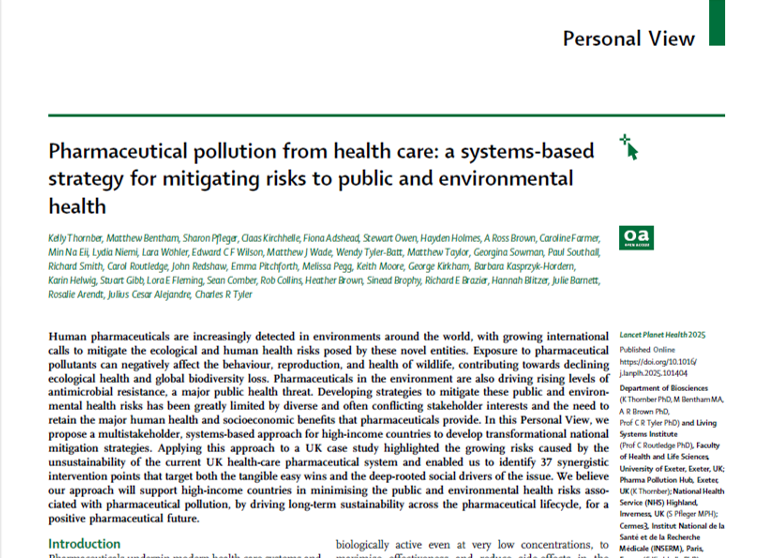
Medicines provide huge health and economic benefits to society but they are also increasingly being found in our water, land and air environments.
Our new paper in the Lancet Planetary Health outlines a ROADMAP FOR ACTION.
Please also see the accompanying POLICY BRIEF.
New research from the Pharma Pollution Hub provides a roadmap for high-income countries to transform the way they supply, use and dispose of pharmaceuticals.
Pharmaceutical pollution is posing growing risks to human and environmental health and prompting increasing calls for action from international bodies such as the United Nations.
Our new research published in the Lancet Planetary Health brought together 48 experts from across the UK pharmaceutical life cycle. Together, we identified 37 intervention points for transformational change. These intervention points focus both on direct and indirect solutions across the whole of society. For example, direct solutions include the need for better wastewater treatment and environmental management. Indirect solutions range from addressing the need to prevent disease and promote alternative (non-pharmaceutical) healthcare treatments, to the need to encourage sustainable corporate investments and ensure financial accountability for the societal costs of pharmaceutical pollution.
Organisations from across the life sciences, healthcare and environmental sectors are increasingly looking for solutions but taking action is not straightforward. The new study provides a roadmap for organisations from across the life sciences, healthcare and environmental sectors to work together and fundamentally change the relationship that we, as a society, have with medicines.
“The societal systems that support pharmaceutical production, use and disposal are complex, unsustainable and deep-rooted in our society, making them very difficult to change.” says Lead author and Pharma Pollution Hub CEO, Dr Kelly Thornber.

“Our work provides a roadmap to build a sustainable pharmaceutical future - this means enjoying the health and economic benefits of medicines without harming the environment at the same time.”
Dr Kelly Thornber, CEO of the Pharma Pollution Hub
Please also see our POLICY BRIEF that summarises this research.
Pharma Pollution Hub Co-Founder, Professor Charles Tyler, has been researching pharmaceuticals in the environment for almost forty years. He said: “We’ve known about the risks of pharmaceutical pollution for a long time, but progress to date has been very limited. Our new approach provides a roadmap for a future UK national mitigation strategy, which we hope will support the UK in becoming a global leader in driving action for a more sustainable pharmaceutical supply and use within society.”
The Pharma Pollution Hub is incredibly grateful to everyone who contributed to this study, including their very generous funders: the University of Exeter and the Medical Research Council.
Our co-authors include partners from across the NHS, AstraZeneca, the UK Health Security Agency, the Scottish Environment Protection Agency, the One Health Breakthrough Partnership, the Sustainable Healthcare Coalition, Healthcare Ocean, the Rivers Trust, the Royal College of Anaesthetists, as well as academics from York Health Economics Consortium, the University of the Highlands and Islands, Sheffield Hallam University, University of Oxford, University of Bath, Glasgow Caledonian University, the University of Plymouth, Lancaster University, Swansea University, and University of Edinburgh (UK), CERMES3 (France), and the University of Twente (Netherlands).
For more information, please email info@pharmapollution.org.